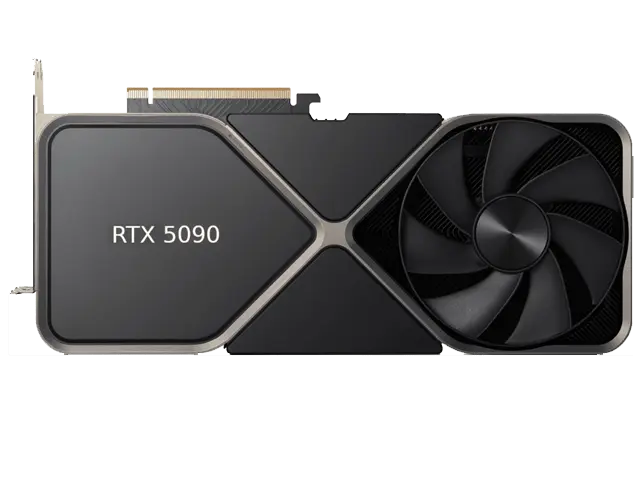
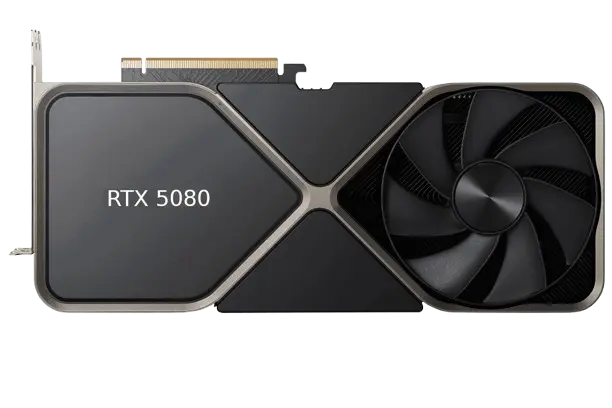
Two Blackwell GeForce cards go into our dedicated servers: the RTX 5090 and the RTX 5080. The card is passed through to your own operating system on a machine rented to one account, so the driver, the CUDA version and the processes on it are yours.
Owners list their RTX 50-series machines on our marketplace and name their own monthly price. A card that says it is listed through our sister company, Server Room, is rented on serverroom.net rather than here.
High-performance NVIDIA RTX 50 series GPU servers built on Blackwell architecture, delivering exceptional performance for gaming, AI acceleration, real-time ray tracing, and professional visualization workloads.
The two Blackwell GeForce cards in our order catalogue. Every figure below is the one NVIDIA publishes on its own GeForce comparison page.
The most card memory of any GeForce part we fit
The same generation for a good deal less each month
The RTX 5090 and the RTX 5080 are PCI Express Gen 5 cards. The server platforms we rack them in are Gen 3 and Gen 4, so the link between card and host runs below the card's design bandwidth. We would rather say that here than let you find out afterwards, because it has already cost one customer a support ticket: an RTX 5090 fitted to a Gen 3 platform rendered slower than the RTX 4090 it replaced.
It matters for a training loop that streams batches across the bus, and it matters not at all for a transcoder, a game server, or an inference server whose weights are already resident in the card's own memory. Which generation each server line gives a card is published, line by line, on the GPU catalogue. Check it against the work you intend to run.
The RTX 50 series introduces groundbreaking advancements in ray tracing, AI acceleration, and graphics rendering, setting new standards for performance and efficiency in GPU computing.
Common questions about deploying and managing your NVIDIA RTX 50 series GPU-accelerated servers for gaming, AI acceleration, and content creation workloads.