Two AMD accelerators go into our dedicated servers: the Instinct MI210 and the Instinct MI50. The card is passed through to your own operating system — your ROCm build, your kernel, your processes, and no hypervisor in between.
Owners list their AMD Instinct machines on our marketplace and name their own monthly price. A card that says it is listed through our sister company, Server Room, is rented on serverroom.net rather than here.
A physical server rented to one account, with an AMD accelerator in a PCIe slot and root on the operating system above it. The card is a line on the invoice rather than a product tier, so the machine underneath does not get more expensive because of what is plugged into it.
Both are orderable today from the same configurator, on different server lines. The figures below are AMD's own published ones.
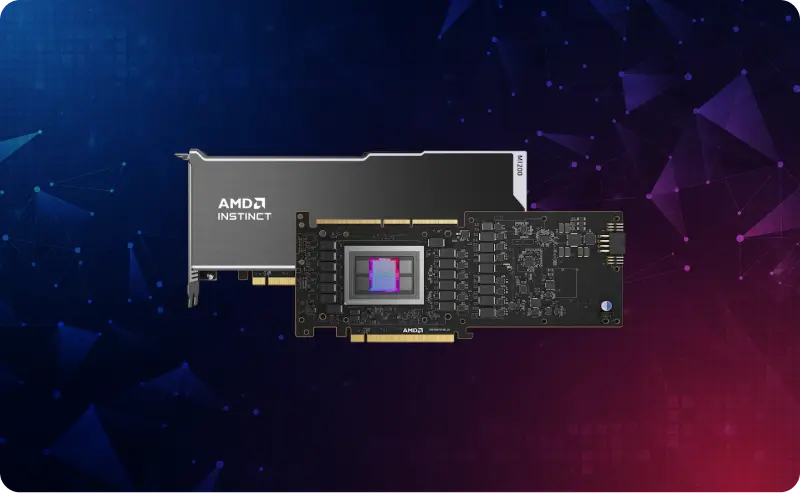
Four accelerators out of the same order catalogue, so this compares parts you can actually put in the same basket. No monthly figures here on purpose: the GPU catalogue reads them from the order catalogue at request time, and a figure typed into this table can drift.
| MI210 | L40S | A100 | H100 | |
|---|---|---|---|---|
| GPU Architecture | CDNA 2 | Ada Lovelace | NVIDIA Ampere | Hopper |
| GPU Memory | 64GB HBM2e | 48GB GDDR6 with ECC | 80GB HBM2e | 80GB HBM2e |
| GPU Memory Bandwidth | Up to 1.6 TB/s | 864 GB/s | 1935 GB/s | 2039 GB/s |
| FP32 | 22.6 TFLOPS | 91.6 TFLOPS | 19.5 TFLOPS | 51 TFLOPS |
| TF32 Tensor Core | — | 366 TFLOPS | 312 TFLOPS | 756 TFLOPS |
| FP16/BF16 Matrix | 181 TFLOPS | 733 TFLOPS | 624 TFLOPS | 1513 TFLOPS |
| Power | Up to 300W | Up to 350W | Up to 300W | Up to 350W |
Common questions about deploying and managing AMD Instinct accelerators on bare metal for AI, HPC, and machine learning workloads.